

IT IS that time of year again, when council tax is set in preparation for the bills which will soon be falling through West Devon letterboxes.
On Friday (February 21), West Devon Borough Council (WDBC) met to give the final nod to the council tax for 2020/21 from April 1 for every household in the borough.
Overall, the bill for an average Band D property is rising by £80.13 for the year, from £1,986.74 to £2,066.87, an increase of 4.03%.
Of this extra £80.13, £55.17 will go to Devon County Council, £5 to West Devon Borough Council, £1.72 to Devon and Somerset Fire and Rescue Authority, £9.36 to the Devon and Cornwall Police and £8.88 to the bill payer's parish or town council.



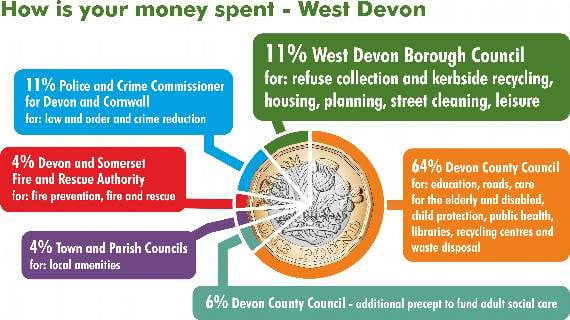
As these figures show, while WDBC sends out the council tax bills to households, its own part of the bill is actually only 11% of the total.
By far the largest proportion is the county council’s, at 64% and a further 6% ring-fenced for social care for an ageing population.
Then Devon and Cornwall Police receives 11% of all the council tax paid, with 4% going to Devon and Somerset Fire and Rescue Service and 4% for parish and town councils.
The amount paid by a Band D household will vary slightly across different communities in West Devon because the council tax demands of each parish or town varies slightly.
With council finances ever tighter with the phasing out of grants from central government, there is often friction between the different tiers of local government over who should pay for what.
This has been seen recently over WDBC’s move to pass responsibility for public toilets from the borough to parish and town councils.
In Tavistock, a lot of work cleaning the streets and looking after public buildings is carried out by the town council, which is a major landlord in the town.
In Okehampton, the town council is also a landlord and caretaker of such assets as Simmons Park, the public park gifted to the town by benefactor Sydney Simmons in the early years of the 20th century.
It has responsibility for maintaining its assets, as well as emptying dog and litter bins and providing toilets and other local amenities.
Not surprisingly, working out which council is responsible for which service is the source of much confusion for residents. Some responsibilties do overlap but others are more clear cut.
In West Devon, the borough council is responsible for planning, social housing and emergency accommodation for homeless people, for street cleaning and for leisure centres. It is also responsible for the kerbside collection from households of rubbish and recycling.
However, it is the county council which is responsible for running recycling and waste disposal sites — these days called material recovery sites — and for waste disposal.
So-called ‘residual waste’, the rubbish left over when everything has been recycled that can be, is no longer sent to landfill in Devon at all.
Instead it is burned under controlled conditions in ‘energy recovery facilities’ with the energy recovered either used directly to heat buildings or to generate electricity.
Other big demands on the county council purse are education and care for the elderly and disabled (social care), public health, libraries and roads and child protection. While these are majorly funded by central government, council tax makes an important contribution.
Comments
This article has no comments yet. Be the first to leave a comment.