
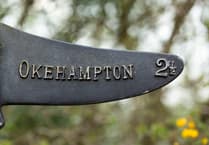
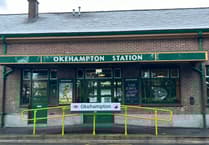
AN ALTERNATIVE Westcountry rail route via Okehampton and Tavistock is being championed by supporters in West Devon and East Cornwall as the way forward following the damage to the main line at Dawlish which has cut off rail links to the region.
Campaigners, who have been pushing for a commuter link from West Devon to Exeter for 14 years, say it is now time to seriously think about the cross country route as the only viable option to the coastal railway.
Cornwall councillor for Gunnislake Dorothy Kirk, a great supporter of the Tamar Valley Line which the new route would link into to go onto Plymouth, said with the exception of the A30 all the roads in Cornwall were inadequate.
'The South West has been so poorly served and so little has been done to improve the rail services to the region compared with what has been done upcountry.


'The people here need and deserve better and with Gunnislake Bridge, linking Cornwall with Devon, closed at the moment that is very evident.'
MPs are calling for urgent debate on the issue and the current crisis has highlighted the need for action. Damage to the track at Dawlish in the recent storms means that the line between Exeter St Davids and Newton Abbot is not expected to re-open until mid-April at the earliest.
MP for South East Cornwall Sheryll Murray said she had raised the issue of trains in the House of Commons and in private meetings with the Transport Secretary.
'I have stressed the urgency of the repairs at Dawlish and also the need for stronger defences so Cornwall cannot be cut off again,' she said.
Network Rail said no firm decision had been made on an alternative route and the priority was to resume rail services to Devon and Cornwall as soon as possible.
'We will take forward a professional study on this once the current situation is resolved, engaging business, local authorities, communities and the rail industry, in the advantages and disadvantages of alternative routes,' said a spokeswoman.
The Plymouth to Exeter line via Okehampton was closed in the 1960s and the land sold off and built on. Network Rail said it would require substantial engineering, including new bridges and viaducts, before a new line could be constructed. The two other alternative routes that are being considered are in South Devon.
Transport Secretary Patrick McLoughlin has said that all options remained on the table and he would enter into the debate once the study was completed.
Author of the Great Railway Conspiracy, David Renshaw, said overall a new cross country line linking Plymouth, Tavistock, Okehampton and Exeter of more than 50 miles in length was a viable option with much of the trackbed intact and the journey time would be faster than the existing route via Dawlish.
'My suggestion is to re-open the northern route as a secondary line rather than replacing the Dawlish line but many faster trains would run that way, some stopping at Okehampton, and it would take over in bad weather,' he said.
Kilbride Rail set up the Bere Alston to Tavistock rail project, the go-ahead for which will be conditional on a housing development for 750 homes being approved in the town. Its managing director Peter Frost said: 'A number of critical decisions are being made in the next few weeks and it is vital all parties continue to work closely together to move the Bere Alston to Tavistock project on as quickly as possible.'
But Cllr Kirk added that she hoped the rail link from Tavistock to Plymouth would not be used as an excuse for building 'massive' amounts of housing in Tavistock and Plymouth.
'The railway will unlock the development of 1,500 homes across Tavistock including 750 homes in an urban extension to the railway station and 4,500 homes on the northern corridor in Plymouth.
'It is predicted that there will be 376 fewer cars on the A386 after the rail link is constructed but once all those homes are built that figure will pale into insignificance. The A386 will be solidly jammed.
'The idea that the railway will put an end to that is simply not true.'
Comments
This article has no comments yet. Be the first to leave a comment.