

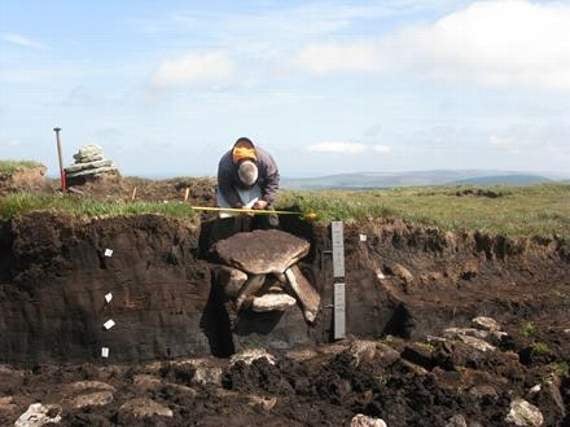
A DIG that unearthed the remains of a Bronze Age burial on north Dartmoor six years ago has been nominated for a prestigious archaeology award.
Archaeologists working for the Dartmoor National Park Authority discovered a unique collection of Bronze Age grave goods on Whitehorse Hill while excavating a prehistoric burial situated at over 600 metres above sea level.
The dig is being nominated for ‘rescue dig of the year’ in the annual Current Archaeology Awards.
The burial, a scheduled monument at risk, was set within an eroding island of peat and was first discovered more than ten years previously. Attempts to prevent it deteriorating further had failed because of its exposed location and the rescue excavation, which began on August 10, 2011, was crucial to help record the important fabric and content of the monument before they were lost forever.
.jpeg?width=209&height=140&crop=209:145,smart&quality=75)



What was discovered was an extraordinary and internationally important collection of Bronze Age grave goods, providing a rare glimpse into the personal and prized possessions of someone who lived on Dartmoor nearly 4,000 years ago.
Along with the cremated remains of a person of slight build aged 15 to 25 years old, the burial contained small textile fragments — possibly the remains of clothing, part of a shroud or a piece of textile that had been used to bind the body. A small amount of charcoaled oak and hazel wood was also present, most likely to have come from the funeral pyre.
The cremated remains and textile were wrapped within a brown bear pelt, which had been laid on top of a fine leather and textile object.
Concealed within the pelt was a beautifully woven basket with its fine stitching still visible. The contents of the basket included over 200 beads, two pairs of wooden studs and a flint tool. A delicate braided woven band featuring 32 tin studs lay beneath the bag.
Many of the beads are made from clay not local to Dartmoor. Others are shale from Dorset. A cylindrical tin bead, traces of a second tin bead which had not survived plus seven amber beads are of great significance.
The tin beads and rivets are the earliest examples of tin objects ever to be found on Dartmoor.
The two pairs of unique wooden studs, which may have been used as body or clothing adornments, are the earliest evidence for wood turning in the UK.
The leather and textile object is a combination of finely woven nettle fibre and thin calf skin and is unique in North Western Europe.
Mike Nendick, communications officer for Dartmoor National Park Authority, said: ‘This unique assemblage of grave goods has given us an insight into ancient materials, technology and trade networks which existed on Dartmoor and across Europe in prehistory.
‘It is a great honour to be nominated for this prestigious award — we hope that people will vote. It was a fantastic project and we are still learning much from the resources generated from the project.
‘If people want to see the range of artefacts found at the site, there are replica artefacts at the Postbridge Visitor Centre along with an exhibition about Bronze Age life and death on Dartmoor.’
Archaeology award winners are chosen by public vote and people can cast their vote now by visiting the website www.archaeology.co.uk/awards
Voting closes on February 5, 2018.
Comments
This article has no comments yet. Be the first to leave a comment.