
A JOURNAL written by a lady from West Devon's Kelly family during the First World War has been published on-line — 100 years after it was written. Margaret Clare Kelly's journal is being posted on the internet by her great-great-niece Sophia Kelly, and provides a glimpse into the life of a privileged woman in the early 20th century in rural Devon. Her journal entries can be read on the Kelly House website on the 100 year anniversary of their writing. Sometimes, especially towards the early days, she writes nightly. As the war progressed, Margaret became embroiled in an effort to be more useful herself, and she went for weeks without an entry. Sophia said: 'While searching Kelly House bookshelves for information about my great-great-uncle Robert Maitland Kelly, who died in the First World War, we came across his elder sister Margaret's war journal. 'Margaret was one of what is known in the family as "The Aunts". 'They were three Boer War widows who ran the place from the early 20th century to the 1930s even though there were men around. As young women they always spoke their mind.' Margaret was the eldest daughter and third child of the Rev Maitland and Mrs Agnes Kelly. She grew up in a wealthy Ottery St Mary household with nine brothers and sisters, but on the death of her uncle Reginald, Maitland inherited the ancestral home, and Margaret moved with him and her siblings to Kelly House in the hamlet of Kelly, near Lifton. Due to the untimely deaths of both her mother and stepmother, Margaret became the lady of the house, organising the day-to-day running of a household with servants, garden staff and a small village of colourful characters. As a young lady, her days were largely concerned with calling at other large houses to 'enquire' and taking tea with other people of her own class, while her siblings were afforded the country pursuits of horse riding, hunting, tennis and writing and producing theatricals in the family-run theatre. Margaret was lucky to have the wealth and freedom to form her own opinions, which she did with zeal. Margaret was something of a contradiction. On one hand she was representative of the staid and unbending British upper classes, and on the other she represented a rebellion against the conservative. As chair of the local Suffrage Society she was calling for more honest and fair representation, at a time when doing so could earn you the enmity of very powerful people. She was of the old school and yet thrust into the most up to date of contraptions — the motor car — in which she would hurtle about the countryside to 'take the air'. Once the First World War broke out, while Margaret had the wealth to own the most precious of dresses, she chose to make her own Red Cross uniform, buying the proper material and sewing in the evening, rather than divert her seamstress from vital war work. She felt that everyone had a part to play. Along with her sister she joined the local Red Cross in the very first days of the war, committing to three drills a week. She organised the village and the households in working groups — she arranged the women of the village to sew shirts and socks for the troops, while the boys in school were put to work knitting mufflers for a navy ship heading to the arctic. At home she rationed butter and put everyone on jam sandwiches for tea, much to her father's dismay. Even the chickens were scrupulously monitored to see how they were contributing. The journal was written at a time of flux — she was using a horse and cart to take the engine of the motor car to be repaired. She was receiving telegrams, using telephones, and hearing of the latest 'wireless telegraphy'. Zeppelins were flying over Europe, Bleriot was navigating the channel, truly massive naval vessels were being launched. The armies of Europe were massing. The horrors of the past were still to be written. To follow Margaret's diary 100 years on, visit the website of her family home — http://www.Kelly-House.co.uk">www.Kelly-House.co.uk
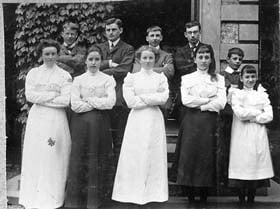
Margaret Kelly and her bothers and sister 1902. Back row, Arthur, Frank, Robert, Evelyn, Reginald; front row, Margaret, Dorothea, Agnes, Mary, Ursula.
.jpeg?width=209&height=140&crop=209:145,smart&quality=75)



Comments
This article has no comments yet. Be the first to leave a comment.